
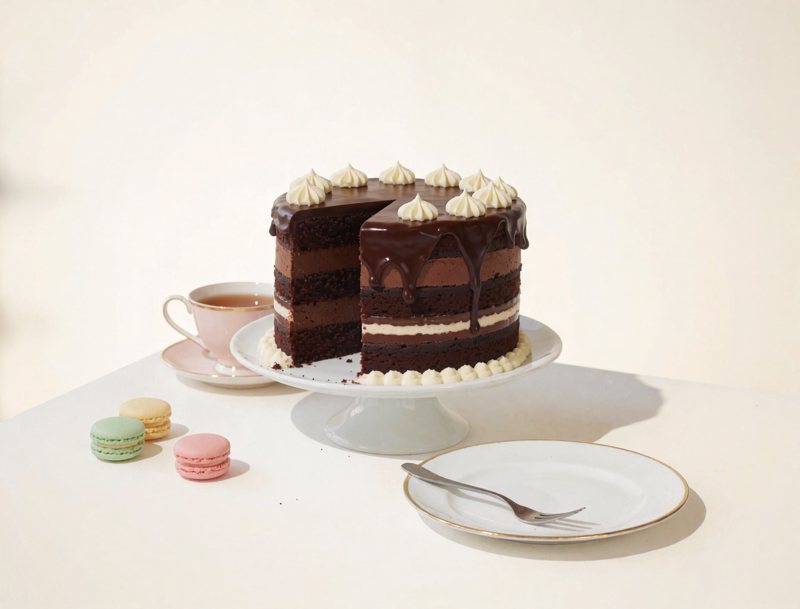
Snickers cake is a chocolate cake built to taste like the bar: chocolate, salted caramel and roasted peanuts. The usual failure is a cake that slides apart when cut, with caramel leaking into the sponge and a mousse that sags. The cause is almost always warm layers stacked on soft ones, not the recipe.
What it is made of
Top to bottom:
- Dark ganache 0.5 cm
The glossy top. It seals the cake and adds a bitter note against the sweet caramel
- Chocolate sponge ×3 · 2.5 cm
The lid over the mousse. It stops the soft mousse from touching the ganache
- Chocolate mousse 2.0 cm
The airy, soft middle that lightens a very sweet cake
- Peanut nougat 0.8 cm
Crunch and the peanut flavour. Without it the cake is just chocolate with caramel
- Salted caramel 0.4 cm
The runny, sharp-sweet layer. Salt is what makes it taste like the bar
- Caramel cream 1.0 cm
A softer caramel layer that holds the salted caramel above it
Three sponges, two caramels, one mousse. It is a tall, soft cake, so build it in a tin or ring, not freestanding.
Order of work
Day before:
- Sponges. Dry and liquid mixed separately, then combined for 10 to 15 seconds, until the dry flour just disappears. Lumps are fine. Long mixing develops gluten and makes the sponge tough. Eggs, milk and butter should be at room temperature. Bake with a baking soda raising agent, because natural cocoa is acidic and soda deepens its flavour and colour. The sign is a dry skewer, and thin layers take much less time than one tall cake, so try and weigh in your own oven. Cool 10 to 15 minutes in the tin, then on a rack. Do not wrap them warm, or condensation makes them gummy. Chilled sponges cut cleanly, which is a general rule.
- Salted caramel. Cook sugar until it is deep amber and smells of caramel instead of plain sugar. Then add warm cream, because cold cream makes the sugar seize and spit. Stir in the salt and cool. The sign is a thick, spoonable caramel that no longer runs off the spoon.
- Nougat. Toast the peanuts, which brings out their oils and flavour, then bind them in a cooked sugar syrup. It is ready when the mass holds together and sets crisp, not sticky. Set it flat in a layer the size of the tin.
- Caramel cream. Cool the caramel to room temperature, then combine it with butter or cream at the same temperature. Mixing different temperatures splits the emulsion. Stop beating as soon as the colour is even.
Assembly day:
- Mousse. Melt the chocolate and cool it to about 40 to 45 °C. If it is hotter it melts the cream, and if colder it sets in flecks. Fold it into cold cream whipped to soft peaks (33 to 35% fat), gently from the bottom up. It is ready when the colour is even and the mousse holds a soft ridge.
- Build upward in the lined tin. Start with the sponge, then caramel cream, with a ring of cream piped round the edge as a dam. Pour in the salted caramel, cooled to room temperature, then add the nougat, the second sponge, the mousse and the third sponge. The dam is what stops liquid caramel escaping.
- Chill hard. Give it 6 to 8 hours in the fridge, until the mousse is firm when you touch the edge. The cold sets the mousse and the fats, so the slice stands up.
- Ganache. Warm cream (at least 30% fat, or the emulsion splits) to 80 to 90 °C, pour it over the chocolate and stir until smooth. Add a little cold butter at the end for shine. Pour at about 34 to 36 °C for a thin coat with drips, or about 28 °C for a thicker one. Check on a glass first. Freeze the cake briefly before pouring so the ganache sets on contact. Drips take about 2 minutes to settle, and you can tidy them with a heat gun.
An optional step to try and weigh: brush the nougat with a thin layer of melted chocolate. It acts as a barrier against the wet caramel, but I have not tested how much it helps.
What can go wrong
- Caramel leaks into the sponge. The dam was too thin, or the caramel was poured hot onto a soft layer. Cool the caramel and pipe a tall rim.
- Mousse sags or weeps. The chocolate was too hot, or the cream was beaten past soft peaks. Over-whipped cream turns grainy and crumbly. Keep the cream at soft peaks and the chocolate at 40 to 45 °C.
- Nougat goes soft. Moisture from the caramel migrates into it. Assemble the same day and consider the chocolate barrier.
- Ganache cracks or dulls. The cream was too low in fat, or too much heat went in. Whisk in a little warm cream.
The verdict
This cake is decided by temperature: cool caramel, a cream dam, a mousse built from cold cream, and a long chill before the ganache goes on.