
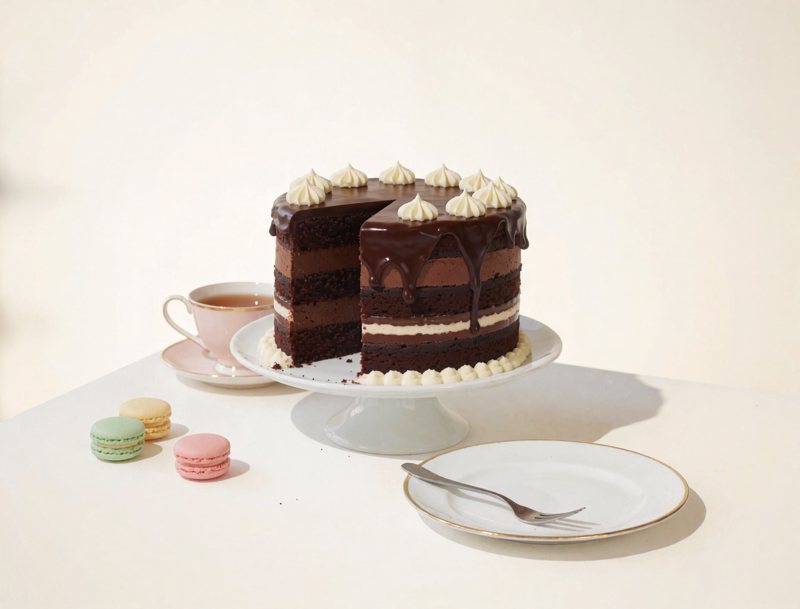
Peanut nougat is a chewy, nutty layer: toasted peanuts held together by thick caramel. In a cake it adds crunch and a salty-bitter contrast to soft sponge and cream. The two usual failures are a caramel that sets so hard it is hard to bite or cut, and a layer that is too thick. Both come from cooking the caramel too far and spreading it too deep.
Ingredients and what each one does
- Peanuts give crunch and flavour. Toasting drives out water, which develops the roasted flavour and keeps the nuts crisp longer once they sit in caramel.
- Caster sugar is the base. Fine crystals melt evenly, so there are fewer burnt patches next to unmelted grains.
- Double cream loosens the caramel. Its fat makes the set chewy rather than glassy, and low-fat milk gives a harder, stickier result.
- Butter adds smoothness and a clean bite, so the layer cuts instead of shattering.
How to make it
- Toast the peanuts at about 160 to 170 °C. Heat removes the water in the nut and builds the roasted flavour. Sign: a nut snapped in half is golden all the way through and smells nutty, not raw. This usually takes 8 to 12 minutes, but ovens differ, so go by the sign. Cool, then chop coarsely.
- Keep the pieces small relative to the layer. For a layer under 1 cm, pieces of roughly 3 to 5 mm sit flat, while big halves poke out and make slicing messy. This is our estimate, so try and weigh.
- Warm the cream to 40 to 60 °C and cube the butter. Cold cream hitting hot sugar boils violently and can seize into lumps, so warm it first.
- Melt the sugar dry in a heavy pan over medium heat, without stirring at first. Stray crystals on the pan wall can seed crystallisation of the whole batch. Sign: the sugar turns to a deep amber and the smell moves from sweet to caramel, roughly 170 to 180 °C. Darker is bitter, lighter is flat.
- Off the heat, add the cream in a thin stream, then the butter. Cream cools the sugar and dilutes it, and butter brings the fat that keeps it soft. Sign: smooth and glossy.
- Cook it back up until it is thick. As a general rule, the hotter the caramel gets, the less water remains and the harder it sets. For a spreadable but chewy layer we would aim for about 108 to 115 °C, but try and weigh on your stove. Check with a cold saucer: a drop should hold its shape after about a minute and feel chewy, not runny, not brittle.
- Fold in the warm nuts off the heat. Enough caramel to coat every piece with little pooling gives the right ratio. Too much caramel makes a soft, sticky layer, and too little crumbles.
- Spread on baking paper while still warm and press to about 0.8 cm. Caramel stiffens quickly as it cools, so shape it before it does. Chill until firm. Sign: it lifts off the paper and bends slightly without cracking, usually 20 to 40 minutes. Cut it to the size of the tin.
Do not put hot nougat directly onto cream: it melts it. Place it only once cool.
What can go wrong
- Rock hard. Cooked too hot, so too little water remains, or too little cream. Next time stop earlier. A batch that has already set can be warmed gently with a spoonful of cream.
- Runny, oozes out of the sides. Undercooked. Return to the heat and re-check on the cold saucer. A ring of cream around the layer also helps hold it.
- Grainy. Stirring too early, or crystals from the pan wall. Add a splash of water and reheat until dissolved. A spoonful of glucose syrup lowers the risk.
- Nuts go soft after a day or two. Moisture migrates from cream and sponge into the nuts. This is normal. Assemble no earlier than needed, and try and weigh how much crunch you want.
- Too thick. Over about 1 cm it is hard to cut and bite. This is partly taste, but a thin layer is far easier to eat.
Substitutions
- Hazelnuts or almonds work the same way, toasted and chopped. Only the flavour changes.
- Salted roasted peanuts can be used as they are, but skip extra salt. With unsalted nuts, a pinch in the caramel sharpens the flavour.
- Milk instead of double cream gives a leaner, harder, stickier caramel.
Storage
Keep the sheet of nougat in an airtight container in the fridge. Our estimate is up to 1 to 2 weeks. Once in a cake, the nuts gradually soften, so it is best eaten within 2 to 3 days.