
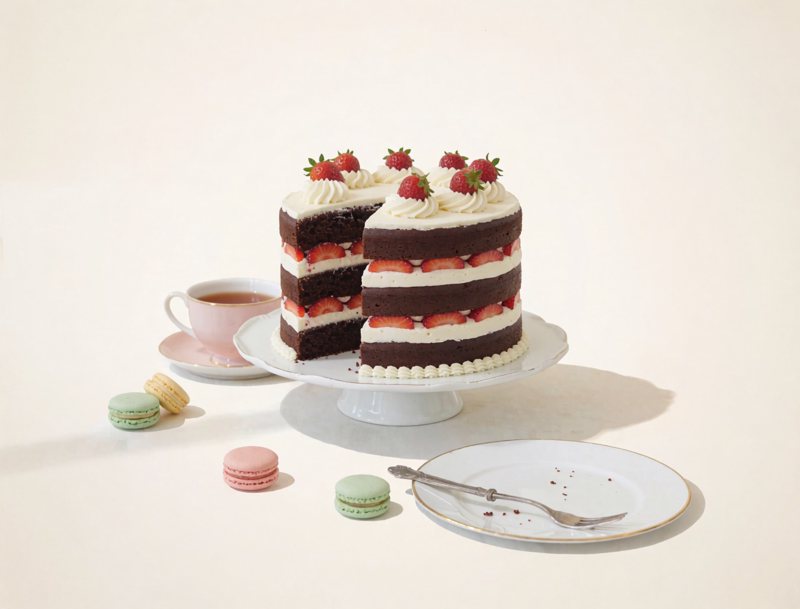
This is a three-layer chocolate cake with fresh strawberries and cream cheese frosting between the layers. The most common failure is a wet, sliding cake. Strawberries release juice, the frosting softens, and the layers slip. The cause is almost never the recipe. It is wet berries and warm layers.
What it is made of
Top to bottom:
- Crumb-coat cream 0.5 cm
A thin layer of cream that seals the crumbs and gives a smooth surface
- Chocolate sponge ×3 · 2.5 cm
The top layer, the lid of the cake
- Fresh strawberries ×2 · 1.0 cm
Acidity and freshness against the heavy chocolate
- Cream cheese frosting ×2 · 1.0 cm
Glues the layers and isolates the sponge from the berry juice
Three sponges, two layers of berries, two of frosting. In the preset the crumb-coat cream is its own layer. In practice it is a thin film of cream cheese frosting, chilled before any final decoration.
Order of work
Day before (or at least 6 hours ahead): the sponges. Use baking soda, not baking powder. Natural cocoa is acidic, and soda deepens both flavour and colour. Eggs, milk and butter should be at room temperature so the batter emulsifies evenly. Mix the dry and wet parts separately, then combine them for 10 to 15 seconds, just until the dry flour disappears. Lumps are fine, while long mixing develops gluten and makes the crumb tough. Dust the tin with cocoa, not flour, so there is no white film. Fill it no more than two thirds.
Add the vinegar last and put the tin straight into the oven. The soda-acid reaction starts at once, and the gas should be released in the heat, not in the bowl. Preheat the oven 20 to 40 degrees above the target, because opening the door drops the temperature. The base recipe for a tall single sponge is 190 °C with convection for about 50 minutes. Thin layers bake faster, and we have not timed this cake, so try and weigh. The sign is a dry skewer, and then another 5 to 10 minutes lets the structure set.
Leave the sponge in the tin for 10 to 15 minutes, then move it to a rack. Do not wrap it warm, because steam turns to condensation and the surface goes gummy. Once cool, wrap it and chill for 4 to 10 hours. Cold sponge cuts cleanly, ideally with a wire.
Frosting. Beat soft butter with icing sugar until it turns pale. Add cold cream cheese and mix for about 30 seconds, no longer, because longer beating makes it runny. A cheap cream cheese works as well as the famous brands. The frosting keeps for 2 days in the fridge, and if it has set hard, just stir it.
Strawberries. Wash, dry thoroughly and slice. Blot the slices on paper towel until the surface is no longer shiny, since every drop of water on them ends up in the frosting. A thickness of about 4 to 5 mm is our estimate, so try and weigh.
Assembly:
- Put the base sponge on a board and spread frosting over it.
- Pipe a ridge of frosting around the edge as a dam. It holds the berry juice in.
- Lay the strawberries inside the dam and cover with the next sponge.
- Repeat, with the third sponge on top.
- Chill for 30 to 60 minutes, then spread a thin layer of frosting over the whole cake. The sign: the crumbs are covered and you can see no sponge through it.
- Return it to the fridge. Cold set frosting is easy to finish smoothly.
Do not put warm layers under cold frosting or cover cold things with warm ones: condensation forms on the surface and the frosting slides.
What can go wrong
- Wet, sliding layers. The strawberries were not dried, or the dam was missing, so juice soaked the sponge.
- Runny frosting. The butter was too warm, or the cheese was beaten too long. Chill for 15 to 20 minutes and mix briefly.
- Crumbs in the finishing layer. The sponge was warm, or there was no thin crumb coat chilled first.
- Tough, dense sponge. The batter was overmixed, which developed gluten.
The verdict
This cake is decided by dry strawberries, a firm frosting dam and cold sponges. The recipe itself matters less than these three details.