
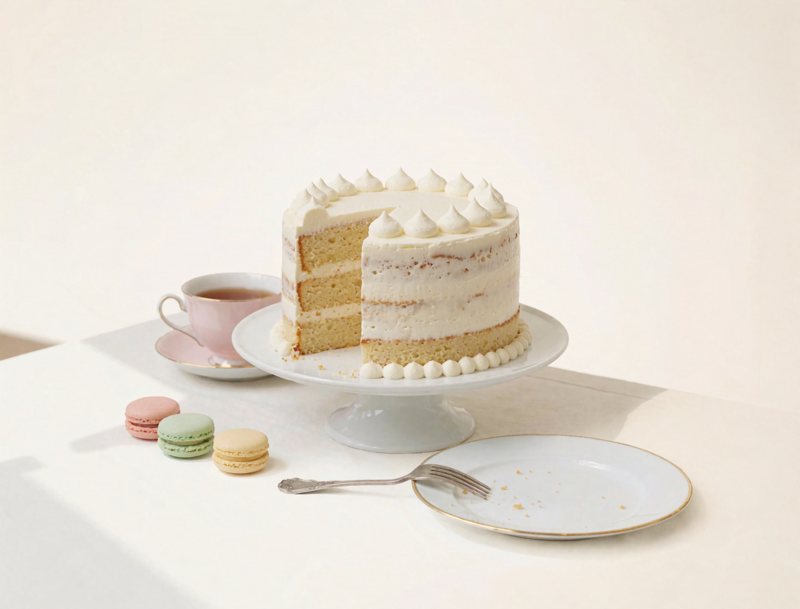
Raffaello cake is a homage to the Ferrero coconut sweet: tender vanilla sponge, plenty of coconut cream, and coconut flakes on top. The usual failures are layers that slip and a sponge that tastes dry despite all the cream. The first comes from warm sponge or soft cream, the second from overbaking, not from a lack of filling.
What it is made of
Top to bottom:
- Coconut cream (Raffaello-style) ×3 · 1.2 cm
The top layer. It holds the coconut flavour and gives you a surface to decorate
- Vanilla sponge ×3 · 2.5 cm
That makes three sponges and three layers of cream. The sponge is a neutral, light crumb that should not compete with the coconut. The cream does two jobs: it is the flavour, and it moistens the dry crumb as the cake rests. The ingredient table on this page shows exactly what goes into each layer.
Order of work
Day before (or the morning before): bake the sponges and make the cream.
Sponge. Bring eggs, milk and butter to room temperature, because cold ingredients make the batter uneven. Mix the dry and wet parts separately, then combine them only until the dry flour disappears. Small lumps are fine; long mixing develops gluten and gives a tough, rubbery crumb (general rule). Fill the tin no more than two-thirds, so the sponge can rise without a dome that has to be trimmed. Preheat the oven 20 to 40 degrees above the target, since opening the door drops the temperature, then bake at about 170 to 180 °C (our estimate; ovens differ, so try and weigh). The sign: a skewer comes out dry and the top springs back under a finger. That usually takes 25 to 35 minutes per layer.
Cooling. Leave the sponge in the tin for 10 to 15 minutes, then turn it onto a rack. Do not wrap it while warm. The steam turns to condensation and makes the surface sticky. Once cool, wrap it and chill it for 4 to 10 hours. Cold, firm crumb cuts and stacks cleanly, and the crumb settles.
Cream. Coconut flakes soak up moisture from the cream, so the cream thickens as it rests. If it looks a little loose after mixing, wait 20 to 30 minutes before adding anything. Do not rush to fix it with extra powder or flour. Taste it: if it is flat, a small pinch of salt sharpens the coconut, but that is a matter of taste, so try and weigh.
Assembly:
- Level each sponge with a serrated knife if it has domed. Level layers keep the stack from leaning.
- Put the first sponge on the board and spread cream over it in an even layer. Our estimate is about 1 cm; thicker feels richer but squeezes out at the sides, so try and weigh.
- Add the second sponge, cream, the third sponge, cream. Press each sponge down gently so no air pocket forms.
- Smooth the top layer of cream, and the sides too if you want them covered.
- Chill the finished cake for 4 to 8 hours. The cold sets the cream and the cream’s moisture evens out into the sponge.
- Add the coconut flakes just before serving, so they stay dry and crisp. Whole almonds or a few Raffaello sweets on top make the homage obvious, but they are optional.
Never put cream on warm sponge. The fat melts, the cream thins, and the layers slide.
What can go wrong
- Layers slide or the cake leans. The sponge was still warm, or the cream was too soft. Chill the sponges fully, and chill the assembled cake before serving.
- The sponge tastes dry. It was overbaked, or the batter was overmixed. Pull it as soon as the skewer is dry, and let the resting time do its work.
- Cream squeezes out at the sides. The layers are too thick or pressed too hard. Use a thinner layer next time.
- Cream looks grainy or separated. The components were at different temperatures. Bring them to the same temperature and re-mix. If it has split badly, warm it gently and whip it again.
The verdict
Raffaello cake is decided by two things: a sponge pulled out when the skewer is just dry, and fully chilled layers with a cream that has had time to settle.