
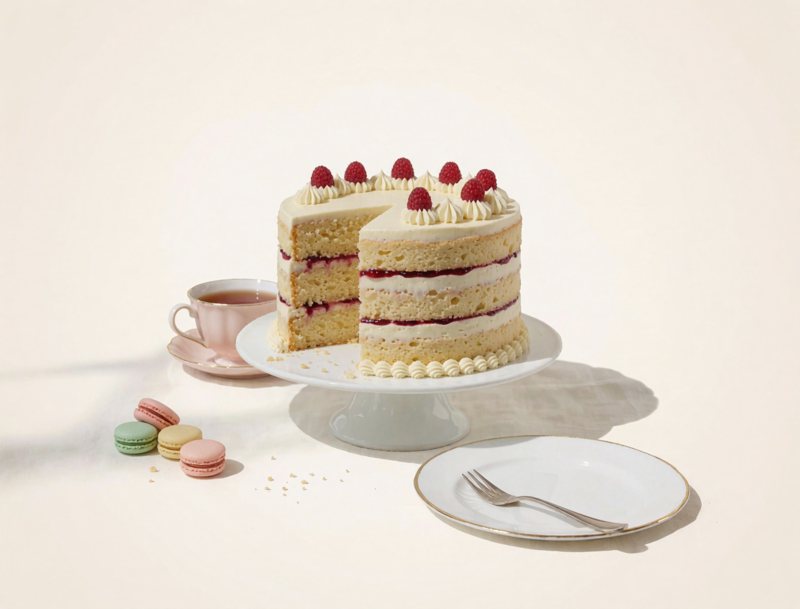
This is a layer cake built on a contrast: rich, fatty pistachio cream against sharp raspberry. Vanilla sponge sits in between and stays neutral. There are two typical failures. The first is layers that slide and a jam that bleeds into the sponge. The second is a pistachio cream that turns heavy and greasy. The first comes from jam that is too runny and has no cream wall around it. The second comes from beating a fatty cream too long.
What it is made of
Top to bottom:
- Pistachio cream ×3 · 1.0 cm
The top layer and the cake’s face. It is also the filling and the outer coat
- Vanilla sponge ×3 · 2.5 cm
A neutral base that carries the flavour of the cream and jam without competing with them
- Raspberry jam ×2 · 0.4 cm
The acid. It cuts the fat of the nut cream and moistens the sponge above it
Three sponges, three creams, two jams. Nut paste is fatty, so the cream tastes heavy on its own. The jam is what makes the cake balanced rather than cloying. The jam is also the wettest component, so it is the one that causes trouble.
Order of work
Day before: sponges and jam.
- Sponges. Bake them until a skewer comes out dry, then let them cool completely on a rack. Warm sponge wrapped in film sweats, and the condensation makes the surface gummy. Once cool, wrap them and put them in the fridge. A cold sponge is firmer and cuts cleanly with a wire or a long knife, and cold also gives crumb that is easier to level. As a general rule, 4 to 10 hours in the fridge is enough.
- Jam. Cook it until it is thick enough that a spoon dragged across the pan leaves a trail that closes slowly. A drop on a cold plate should hold its shape rather than spread. Thick jam stays where you put it, while thin jam soaks into the sponge and lubricates the layers. Cool it fully before assembly. Warm jam melts the cream underneath it.
Assembly day: cream.
Keep everything cold, including the cream base, the bowl and the paste. If the cream is whipped cream with pistachio paste folded in, first loosen the paste with a spoonful of the cream, then fold it into the rest. Dense paste dropped into airy cream leaves lumps, because the two don’t mix at different densities. Whip cold cream of 33–35% fat to soft peaks and stop there. Nut paste adds fat, which makes the cream firm up faster than plain whipped cream, so stop a little earlier than you think. Over-whipped cream turns crumbly and then greasy, and this cannot be reversed. Try and weigh: the right stopping point depends on your paste.
On colour: natural pistachio paste gives a muted, olive-green cream, not a bright one. If you want it brighter, that is a matter of taste, not technique. Dye changes nothing in the structure.
Assembly:
- Level each sponge so the top is flat. A flat layer distributes weight evenly, while a dome makes the tiers lean.
- Put the bottom sponge on a board or plate and spread a layer of pistachio cream over it.
- Pipe or spread a ring of cream around the edge. This is the “dam”, and it keeps the jam inside the cake.
- Fill the ring with a thin layer of cool, thick jam. Thin means you can still see the cream wall above it. Try and weigh: too much jam is the first cause of sliding.
- Add the next sponge, press lightly and repeat.
- Cover the top and sides with the remaining pistachio cream. The sign that the surface is ready is that the sponge no longer shows through and the edges are straight when you look at them from the side.
Resting: 4 to 8 hours in the fridge, or overnight. The cold sets the fat in the cream so the tiers hold together, and the moisture of the jam spreads gently into the sponge. Only a cold cake slices cleanly. Don’t put a warm sponge or warm jam under cold cream. Cold covered by warm gives condensation and a slippery interface between layers.
What can go wrong
- Layers slide or the jam leaks out. The jam was too thin or too warm, or the cream wall was missing or too low. Cook the jam thicker and rebuild the wall.
- Pink, soggy patches in the sponge. Too much jam, or jam that was not thick enough. Use less, spread it evenly and keep it away from the edge.
- Greasy, crumbly pistachio cream. It was over-whipped or the paste was added warm. Don’t try to rescue it with more cream. Start again and stop earlier.
- Lumps of paste in the cream. The paste was not loosened first. Fold in a spoonful of cream before the rest.
- Cake falls apart when sliced. Too little time in the cold, or a dull knife. Wipe the knife between cuts.
The verdict
This cake is decided by two things: a thick, cool jam inside a cream wall, and a pistachio cream stopped before it turns greasy.