
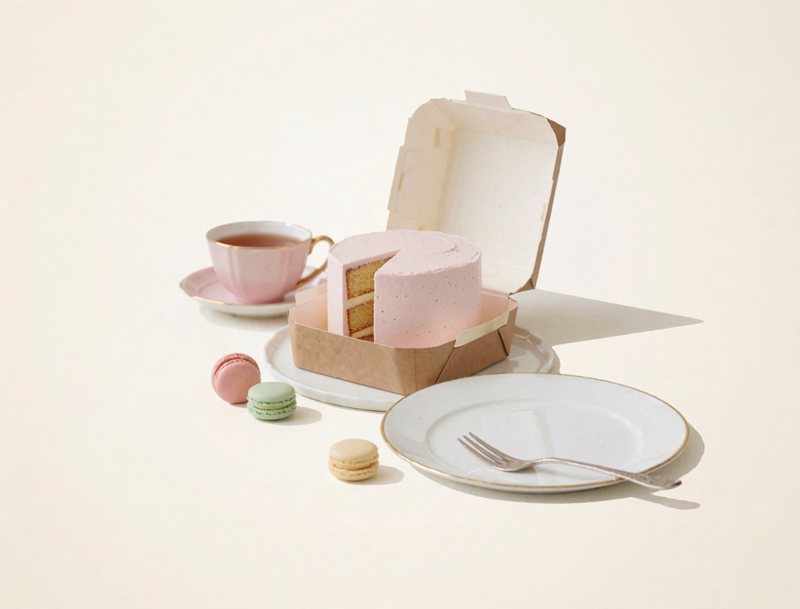
A bento cake is a small cake, about Ø10–12 cm, sold in a takeaway box. It is meant for one or two people and eaten with spoons straight from the box. The name comes from the Japanese bento lunch box, and the format spread through Korean cafés and social media. The usual failures are a lumpy, streaky coat and a cake that slides or sweats in the box. Both come from warm cream, not from lack of decorating skill.
What it is made of
Top to bottom:
- Crumb-coat cream 0.5 cm
The thin first coat that traps crumbs and levels the sides. The final coat goes over it
- Vanilla sponge ×3 · 1.5 cm
The top layer, thin
- Berry confit ×2 · 0.5 cm
A tart, jammy layer that cuts the sweetness of the cream
- Cream cheese frosting ×2 · 0.8 cm
Glue between layers, and the dam that keeps the confit in
The sponges are thin on purpose. At Ø10–12 cm, three thin layers give more bites with cream and confit than one tall one. A cake that is too tall also wobbles in a box. As a rule of thumb, about 1 cm per sponge is a good starting point, but try and weigh it for your own box.
Cream cheese frosting is a good coat for three reasons. It is firm enough when cold to hold a clean edge, it takes pastel colour well, and it survives a closed box better than whipped cream. It is softer than a classic butter cream, though, so everything depends on keeping it cold.
Order of work
Day before: bake the sponge and cool it fully. Cooking the confit and letting it cool completely also works a day ahead. A warm layer melts the frosting under it. Cut the discs with a ring or a knife and a template.
Frosting: beat soft butter with icing sugar until pale, then add cold cheese and stop as soon as it is smooth. Over-beaten cream cheese loosens and turns runny, and you cannot rescue it by adding more sugar. If it is already runny, chill it first, then stir gently.
Assembly:
- Pipe a ring of frosting around the edge of the base sponge. It is a dam that holds the soft confit in. The sign: the ring stands up and keeps its shape.
- Fill the ring with confit and level it. Cold confit does not spread into the frosting. Do not overfill, or it will squeeze out when you press the next layer.
- Add a thin layer of frosting, then the next sponge, and repeat. Press lightly and check from above that the stack is straight.
- Chill the stack until the sides feel firm and do not dent under a light touch (our estimate is 20–40 minutes, try and weigh). Cold fat holds the layers together while you coat.
Smooth pastel coat:
- Crumb coat: spread a thin layer over the top and sides. It traps loose crumbs so they don’t show in the final coat. Chill until it feels dry and firm (about 20–30 minutes).
- Colour the frosting for the final coat. Gel colour has less water than liquid colour, so it won’t thin the cream. Add a little on a toothpick and mix. Colour deepens as the cake rests, so aim a shade lighter than you want.
- Final coat: put on more than you need, then scrape it back with a straight scraper. The sign: the surface is even, with no streaks.
- For a polished finish, dip the scraper in hot water, wipe it dry and pass it over the cream once. The warm metal melts the very top film. If you pass it repeatedly, you will melt it into a mess.
Boxing and transport:
- Chill the finished cake until it is hard to the touch (at least a few hours, try and weigh).
- Put it on a cake board that fits snugly in the box and close the box while the cake is still cold. General rule: a cold cake brought into a warm room gets condensation (dew point), which spots the coat and smudges the writing.
- Carry it flat, on a level surface in the car, and keep it cold with a cool bag. Don’t let ice packs touch the box.
- Eat within 1–2 days. The sponges soften and the confit seeps over time.
What can go wrong
- Streaky, lumpy coat. Frosting that is too soft or too warm, or the cake was not chilled between coats. Chill and re-coat.
- Confit leaking out the side. The dam was too low, or the confit was warm. Next time, pipe the ring taller and use cold confit.
- Runny frosting. Over-beaten cream cheese or warm butter. Chill it and stir gently.
- Lettering spreads. The cream was too soft, or the cake was warm.
- Cake slides in the box. Not chilled before boxing, or the box is too big. Choose a snugger box.
What to write on it: bento cake inscription ideas by occasion, up to 25 characters.
The verdict
A bento cake is decided by cold. Cold, firm layers, a tall dam, a chilled crumb coat and a hard-chilled cake before lettering and boxing are what make it look sharp and arrive intact.