
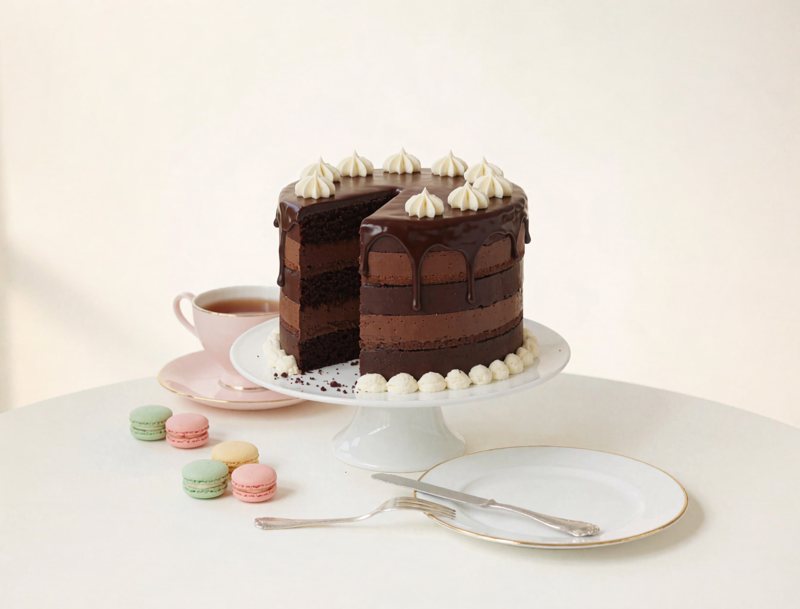
Ferrero cake is a cake built on the flavour of Ferrero Rocher candies: dark chocolate, roasted hazelnut and something crunchy. It is a modern dessert, not a traditional recipe, so there is no “correct” version. Two failures are typical. The crunch turns soft and chewy, and the mousse is either runny or full of chocolate flecks. The first comes from water reaching the crunch, the second from chocolate at the wrong temperature when it meets the cream.
What it is made of
Top to bottom:
- Dark ganache 0.5 cm
The glaze: it seals the top, shines and gives a bitter edge to balance the sweetness
- Chocolate sponge ×3 · 2.5 cm
The top tier, a soft base for the ganache
- Chocolate mousse ×2 · 2.0 cm
A light, airy layer that adds moisture to the sponge
- Hazelnut praline crunch ×2 · 0.6 cm
The “Rocher” part: nutty, crisp, fat-bound
Three sponges, two mousses, two crunches. The sponge is the structure, the mousse is the softness, the crunch is the texture contrast. Without the crunch it is just a chocolate cake. Use the ingredient table for quantities.
Order of work
Day 1: sponge and crunch.
- Sponge. Mix dry and liquid separately and combine them for only 10 to 15 seconds, until the dry flour has just disappeared. Lumps are fine. Longer mixing develops gluten, and the sponge turns tough and rubbery. Cocoa is acidic, so soda (not baking powder) is the usual raiser, and it deepens the colour. Fill the tin no more than two thirds. The sign of doneness is a dry skewer, then leave it in the oven another 5 to 10 minutes to set the structure. Thin layers bake faster than a tall sponge, so check early. That is our estimate, so try and weigh it in your oven.
- Cooling. Rest 10 to 15 minutes in the tin, then turn out onto a rack. Do not wrap it warm, because condensation makes the surface gummy. Chilled sponge cuts cleanly, so cut it into layers with a wire or a long knife once it is cold.
- Crunch. Stir the crisp component (crushed wafer or cereal flakes) into melted chocolate and praline. The fat coats every piece and forms a barrier against water. The sign: the mass looks glossy and holds together when pressed, with no dry crumbs. Spread it thin and chill until firm to the touch.
Day 2: mousse and assembly.
- Mousse. Melt the chocolate and let it cool to about 30 to 35 °C. This is a general rule: hot chocolate melts the whipped cream, and cold chocolate sets into flecks on contact. The sign: it is fluid, and warm but not hot on your lip or wrist. Whip cold cream (33 to 35% fat) to soft peaks, the sign being a tip that bends over. Fold it in gently, from the bottom up, in two or three portions. The mousse is ready when it is a uniform colour with no white streaks.
- Assembly, bottom up. Use a ring with an acetate collar. Order: sponge, crunch, mousse, sponge, crunch, mousse, sponge. Put the crunch on a firm, cold layer, and chill each mousse layer for a while before the next sponge goes on. How long depends on your kitchen, so try and weigh.
- Set. Chill for 6 to 8 hours. The cocoa butter in the chocolate hardens and the cake becomes sliceable. This is our estimate, not a measured figure.
Ganache. Heat the cream (at least 30% fat, or the emulsion splits) to 80 to 90 °C, pour it over chopped dark chocolate, and stir until smooth. Add a little cold butter at the end for shine. At 34 to 36 °C the ganache is fluid and gives thin drips. At about 28 °C it is thicker. Test it on a glass. Pour it over a cold, well-chilled cake and leave the drips for about 2 minutes. Fix them with a hairdryer if needed.
What can go wrong
- Soft, chewy crunch. Water from the mousse got into it. Cause: a crunch layer that was too thin or not set, or the crunch put on warm mousse. Fix it by chilling it until firm and sealing it with a thin layer of chocolate.
- Flecks in the mousse. The chocolate was too cold when it met the cream. Cause: temperature, not the mixing. Fix it by warming the chocolate to the 30 to 35 °C range.
- Runny mousse. The cream was under-whipped, or there was too little chocolate. More chocolate gives a firmer set. Milk chocolate sets softer than dark, a general rule.
- Cracking ganache on cutting. The cake is very cold and the ganache has set hard. Use a knife warmed in hot water and wiped between cuts.
The verdict
Ferrero cake is decided by the temperature of the chocolate when it meets the cream, and by keeping the crunch dry behind a layer of fat. The rest is patience in the fridge.