
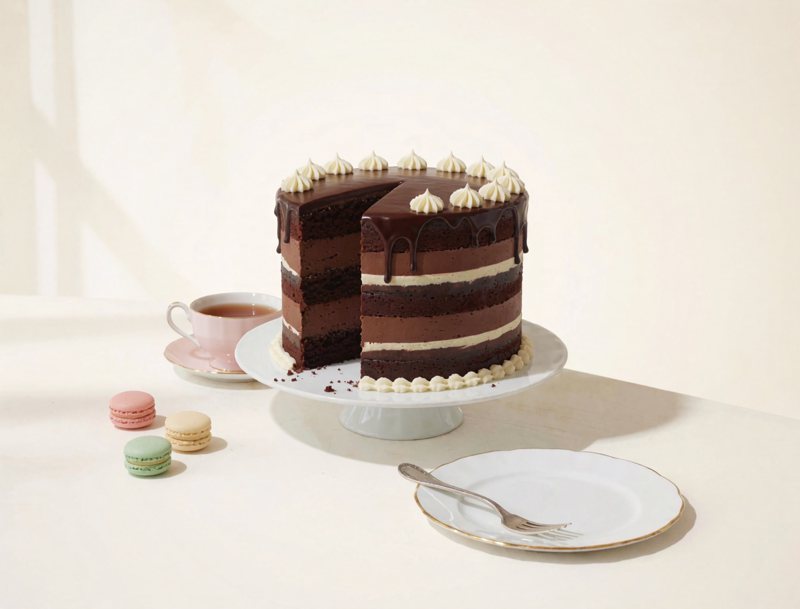
Dubai chocolate cake is a cake version of the viral chocolate bar with a crunchy pistachio and kataifi filling. Kataifi is shredded phyllo pastry. The typical failures are a soggy kataifi layer and a mousse that slides out when you cut. The first comes from water moving from the mousse into the crisp strands, the second from a mousse that was not cold enough when sliced.
What it is made of
Top to bottom:
- Dark ganache 0.5 cm
The glossy coating, which also seals the top sponge from air
- Chocolate sponge ×3 · 2.5 cm
The top tier. It holds the weight and gives a soft, not-too-sweet contrast to the mousse
- Chocolate mousse ×2 · 2.0 cm
The light, airy layer. It keeps the cake from being heavy and dry
- Pistachio kataifi ×2 · 0.8 cm
The crunchy layer: toasted strands bound with pistachio paste
Three sponges, two mousses, two kataifi layers. The sponge is a plain chocolate one, made with baking soda because natural cocoa is acidic. The mousse is soft and cold-set, so everything depends on temperature. The kataifi layer is what makes it “Dubai”.
Order of work
Day 1: sponges and kataifi.
Sponges: bake them with the baking-soda method. Mix dry and wet separately, then combine until the dry flour just disappears (about 10 to 15 seconds). Lumps are fine, and long mixing builds gluten and gives a tough crumb. Eggs, milk and butter should be at room temperature. The sign of doneness is a dry skewer, then another 5 to 10 minutes to set the structure. Exact time depends on how thin you make the layers, so go by the skewer. Cool in the tin for 10 to 15 minutes, then on a rack. Do not wrap them warm, because condensation makes the surface gummy. Chill for 4 to 10 hours, which makes them easy to trim and cut cleanly.
Kataifi: chop the strands, toss with melted butter and toast until golden and fragrant, usually 8 to 15 minutes at moderate heat while stirring. The butter coats the strands, which crisps them and slows water uptake. Cool completely before mixing with the pistachio paste. Warm strands steam and go soft.
A note on colour: a neon-green filling usually means added colouring. Real pistachio paste is a dull olive green, and that is normal.
Day 2: mousse and assembly.
Mousse: melt the chocolate and let it cool to about 30 to 35 °C before folding it into cold cream whipped to soft peaks (cream at 33 to 35% fat). This is a general rule: hot chocolate melts the air out, and chocolate that is too cold seizes into flecks. Fold from the bottom up and stop when the colour is even. Over-whipped cream turns crumbly and buttery.
Assembly: use a ring with an acetate collar, building from the bottom:
- Sponge.
- Kataifi, pressed into a compact layer.
- Mousse, spread level.
- Sponge.
- Kataifi.
- Mousse.
- Sponge.
Mousse cannot act as a cream dam, so the ring does that job. Chilling for 20 to 30 minutes after each mousse layer helps the next sponge sit without sinking. Treat that as our suggestion: try and weigh.
Another suggestion to try and weigh: brush a thin layer of melted dark chocolate over the sponge under the kataifi. It makes a barrier against moisture, and the crunch should last longer. Cover and chill the finished cake until the mousse is firm (the sign is that a knife leaves a clean edge), roughly 6 to 12 hours.
Ganache: heat the cream (at least 30% fat, otherwise the emulsion splits) to 80 to 90 °C, pour it over the chocolate, stir smooth, then add cold butter for shine. At 34 to 36 °C the ganache is fluid and makes thin drips, and at about 28 °C it is thicker. Test on a glass. Freeze the cake briefly, pour, and fix drips with a hair dryer within about 2 minutes.
What can go wrong
- Soft kataifi. Strands were not toasted fully, were mixed warm, or the cake sat too long. General rule: crunch fades as the mousse’s water migrates, so it is best on day 1 to 2.
- Mousse slumps when cut. Not chilled long enough, or the chocolate was too warm when folded in, so the air was lost.
- Grainy mousse. Cold cream met overly cold chocolate, or the cream was over-whipped.
- Dull or split ganache. Cream with too little fat, or butter added while the ganache was too hot.
The verdict
This cake is decided by the crunch of the kataifi and the cold set of the mousse. Toast the strands well, keep every layer cold, and serve it within a day or two.