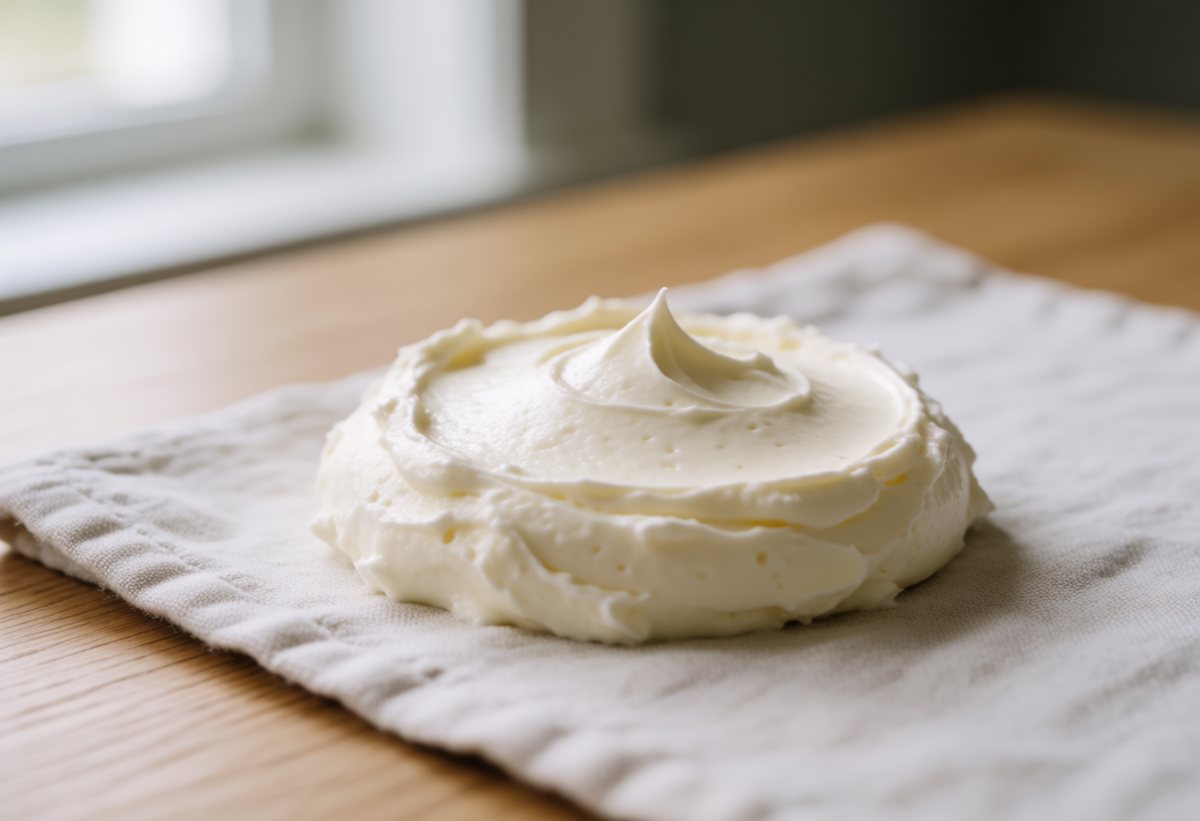
Mascarpone cream for tiramisu is soft, thick and very sensitive to mixing speed. The usual failure is a grainy, split cream with liquid in the bowl. The cause is overbeating: mascarpone’s fat structure breaks down quickly.
Ingredients and what each one does
- Mascarpone gives the body, the richness and the thickness. It is already creamy and needs no heat.
- Heavy cream (33 to 35% fat) adds air and volume. It must be cold or it will not whip.
- Powdered sugar dissolves without heat and keeps the cream smooth.
- Eggs (yolks) add silkiness. Raw yolks carry a risk, so use pasteurised ones or cook the yolks with sugar over a water bath to about 70 to 75 °C.
How to make it
- Mascarpone and cream cold, straight from the fridge. Warm cheese turns runny and grainy.
- Whip the cream separately to soft peaks. Sign: the foam keeps the whisk’s trail but the tip folds over. Stiff peaks are harder to blend.
- Stir the mascarpone with the sugar and the cooled egg base with a spatula, or a mixer on the lowest speed, only until smooth.
- Fold in the cream in two additions from the bottom up. Do not beat. Stop as soon as the white streaks are gone.
- Use right away or keep it cold until assembly.
What can go wrong
- Grainy, with visible whey. Overbeaten. It is hard to recover. You can try folding in a little more cold cream very gently, but the smoothness is gone.
- Runny. The cheese or the cream was warm, or there was too much cream. Chill for 30 minutes.
- Sour edge. Too little sugar, or the cheese was not very fresh.
- Wet layer on the biscuits. Normal. The cream sinks into the ladyfingers and sets during 6 or more hours in the fridge.
Substitutions
Cream cheese, or sieved ricotta, can replace mascarpone but tastes tangier and less creamy. A little extra sugar can be added to the cream if you need a firmer shape.
Storage
Two days in the fridge, as part of the assembled cake. If it firms up, stir it. It does not freeze well.