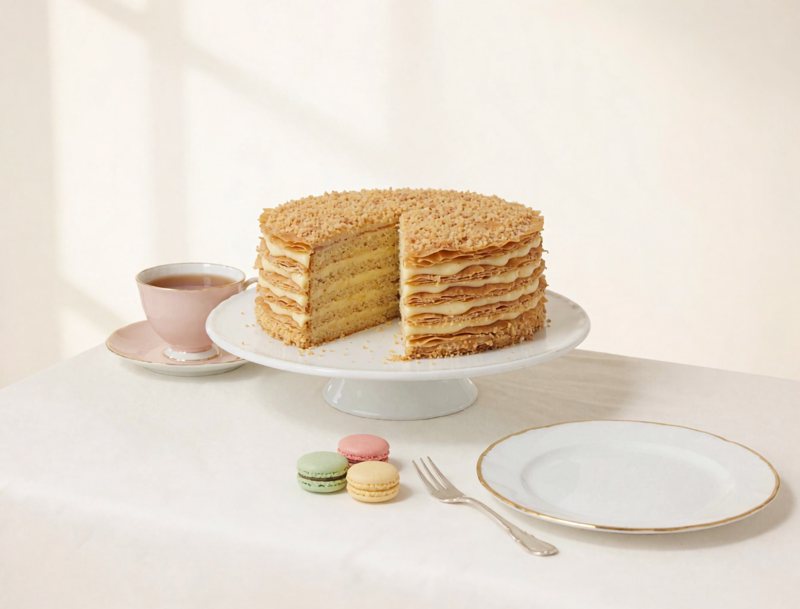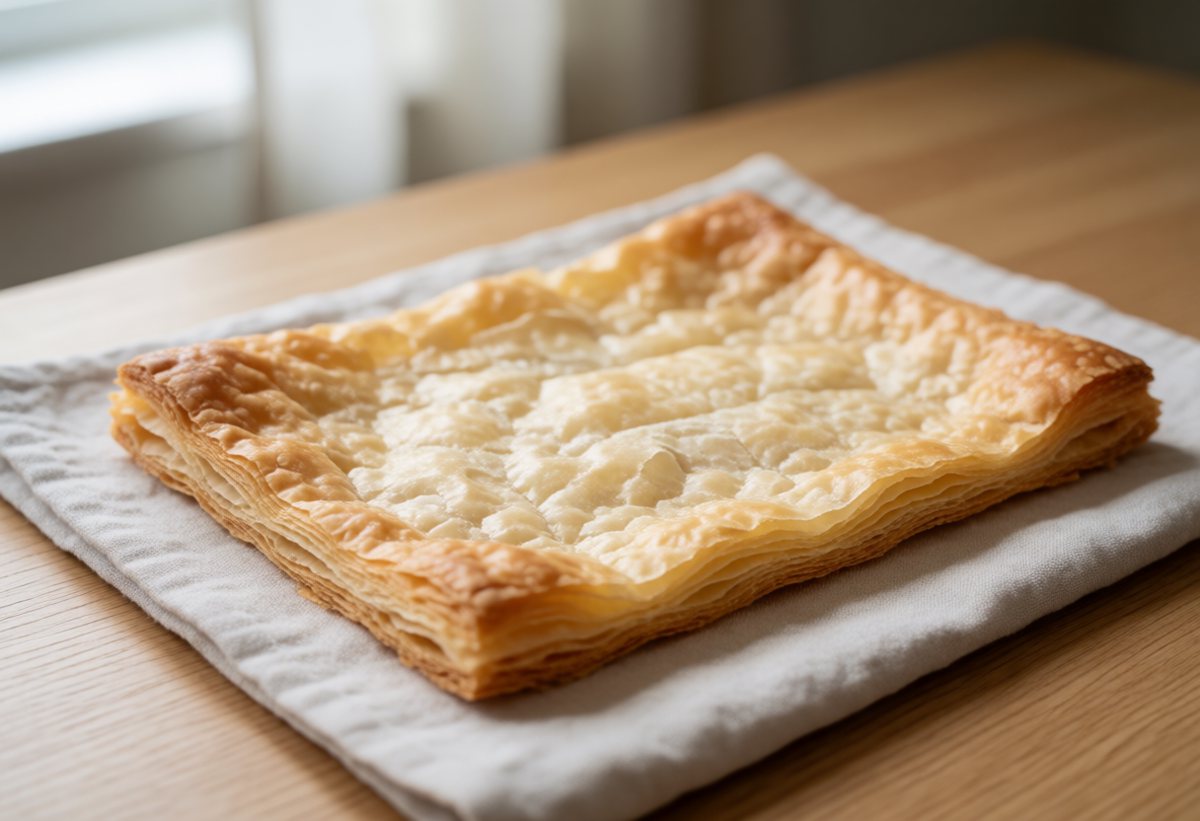
Puff pastry rises on steam: water in the dough and butter turns to vapour between layers of fat and pushes them apart. For a Napoleon-style cake you want thin, flat sheets, not tall airy puffs. The main failure is butter leaking out, leaving the pastry dense and greasy.
Ingredients and what each one does
- Flour forms the dough layers. A strong flour with higher protein is better: the gluten makes the dough elastic, so it doesn’t tear when rolled.
- Butter makes the sheets of fat between the dough layers, giving flakiness and flavour. It must stay firm and pliable (around 12–16 °C), not melted.
- Also a little cold water and salt (outside the table) to bring the dough together.
How to make it
- Mix a simple dough of flour, cold water and salt and rest it in the fridge so the gluten relaxes.
- Shape the butter into a flat block and wrap the dough around it like an envelope. Dough and butter should be similar in firmness: if the butter is harder it shatters, if it’s softer it squeezes out.
- Roll out and fold several times (single or double folds), chilling for 20–30 minutes between turns. Warmth is the enemy: the butter melts into the dough and the layers merge. If the dough gets soft and sticky, put it in the fridge rather than adding flour.
- For a Napoleon, divide the dough, roll it thin (about 2–3 mm) and cut to a template.
- Prick each sheet thoroughly with a fork. Bake between two trays, or under a weight, on parchment at 200 °C until deep golden. Pricking and weight restrain the puff, while the high heat quickly turns water to steam, so the layers separate and brown. Thin sheets come out flat and crisp.
- Cool on a rack. Bake the trimmings too: crumbled, they coat the outside of the cake.
What can go wrong
- Butter leaked out. The dough was warm or the oven not hot enough, so the butter melted before the dough set.
- Didn’t flake. The butter melted or blended into the dough during rolling, so no layers of fat were left.
- Domed up. Too few pricks, or no weight on top.
- Pale and soft. Underbaked; the golden colour is the flavour.
Substitutions
Store-bought puff pastry is a fair shortcut for Napoleon; check it is made with butter rather than margarine, because the flavour differs. In a quick “rough puff” version, cold butter is grated or cut into the flour: fewer layers and coarser sheets.
Storage
Raw dough keeps a few days in the fridge, or months in the freezer. Keep baked sheets dry, 2–3 days in an airtight box, and assemble the cake a few hours before serving so the cream can soften them.