
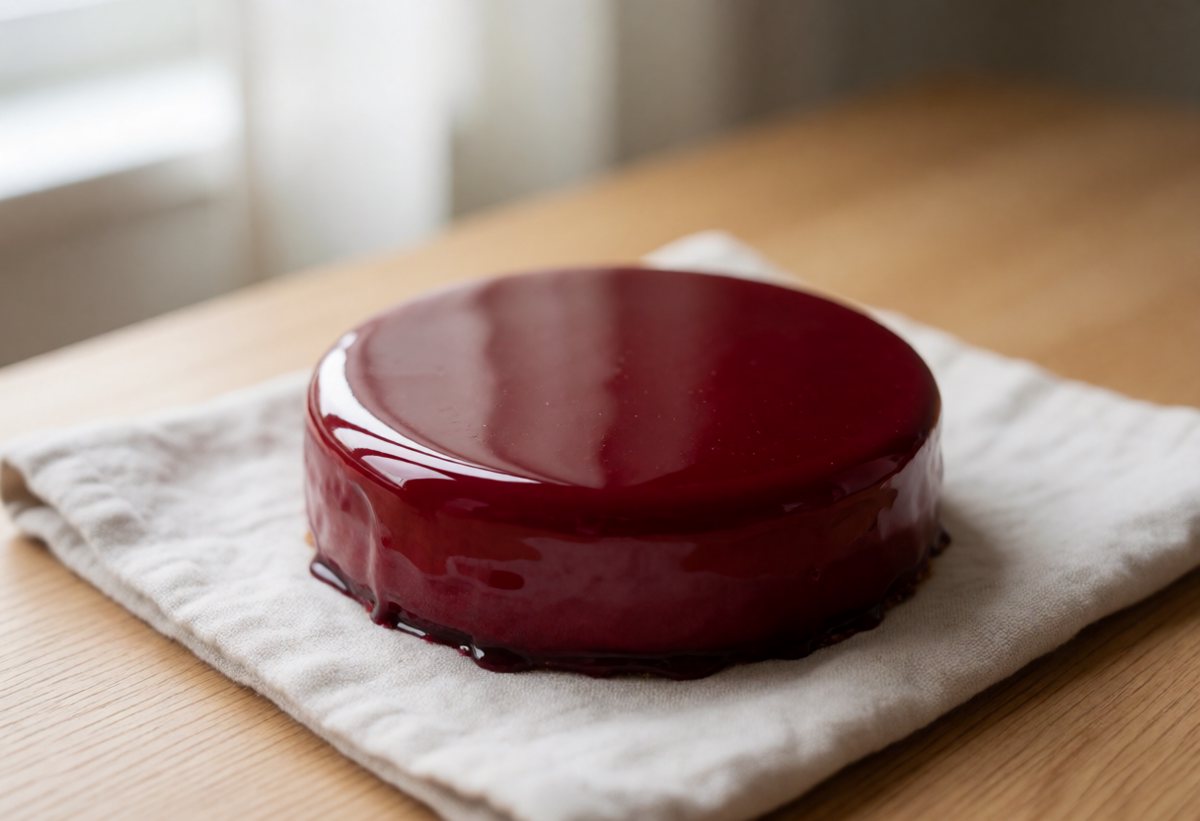
Mirror glaze is the glossy coat that is poured over a frozen cake. The usual problem is a glaze that is too thin and runs off, or too thick and lumpy. The cause is almost always the pouring temperature.
Ingredients and what each one does
- Sugar and glucose syrup make the base syrup. Glucose stops the sugar from crystallising and adds shine.
- White chocolate makes the glaze opaque and creamy and adds fat.
- Gelatine sets it and gives the springy, mirror finish. It is bloomed in cold water first.
- Water is needed for the syrup, and colour is added to taste.
How to make it
- Bloom the gelatine in cold water for 5 to 10 minutes until soft.
- Boil the sugar with the glucose and water until everything is dissolved.
- Off the heat, add the squeezed gelatine and stir until dissolved.
- Pour the syrup over the white chocolate, wait a minute, then blend with a stick blender. Keep the blender head fully under the surface, or air bubbles form.
- Add the colour and blend again under the surface. Strain through a sieve.
- Cover with film touching the surface and cool to 32 to 35 °C. Pour over a frozen or well-chilled cake. The cold cake grabs the glaze at once so it cannot run off completely.
- Pour in one movement, in a spiral from the centre. The excess drips off by itself.
What can go wrong
- Bubbles. The blender pulled in air. Blend below the surface and strain. Surface bubbles can be popped with a toothpick.
- Runs off, see-through. Too warm. Wait until 32 to 35 °C.
- Thick and lumpy. Too cold: the gelatine has started to set.
- Dull. The cake was not cold enough, or the glaze was stirred too much.
Substitutions
Agar can replace gelatine but the texture is more brittle and less elastic. Without glucose, sugar crystallisation is more likely.
Storage
The glaze keeps a week in the fridge. Reheat slowly to 32 to 35 °C before use. Keep a glazed cake cold, because the shine dulls at room temperature.