
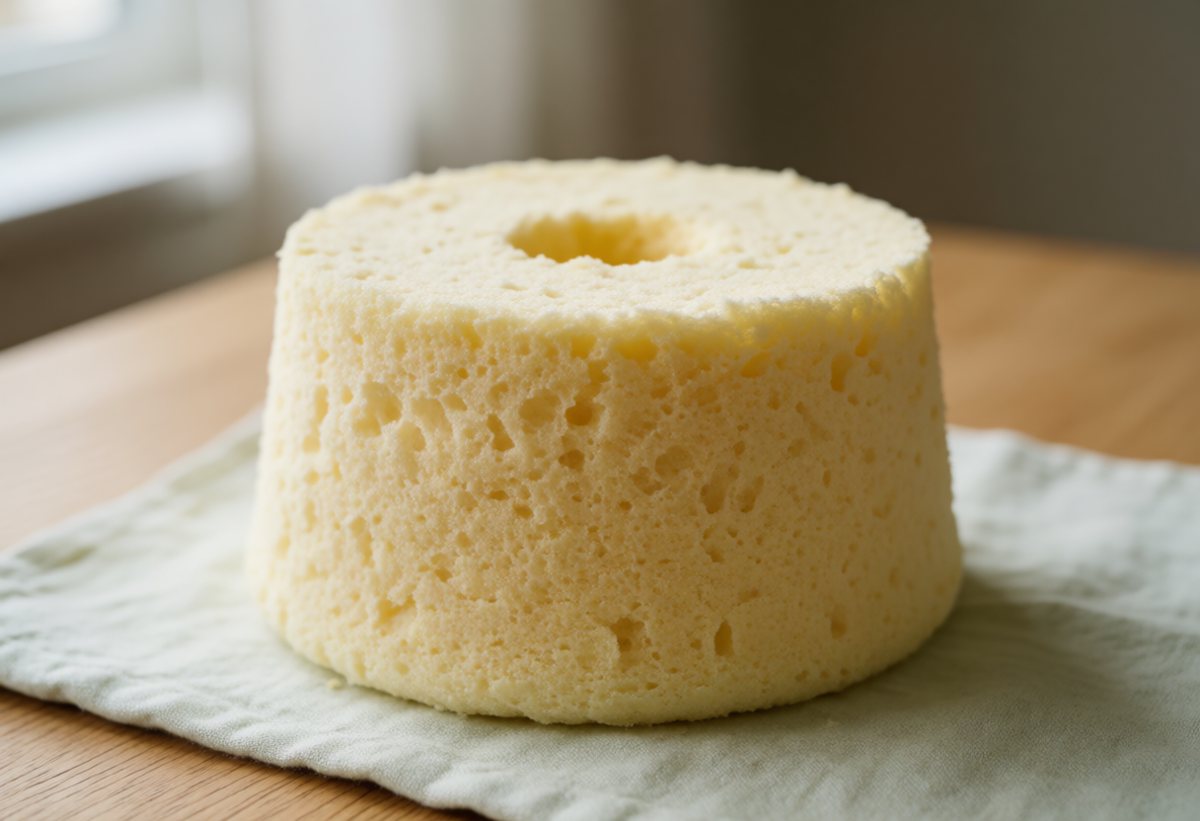
Chiffon sponge is very light yet moist, because it relies on both whipped egg whites and oil. The crumb is springy rather than crumbly. The main trap is sinking: the foam was deflated, or the cake was taken out of its tin too early.
Ingredients and what each one does
- Eggs are separated: the yolks go into the batter, the whites are whipped separately into a strong foam that lifts the cake.
- Sugar goes partly into the yolk mixture and partly into the whites, where it steadies the foam.
- Flour is the frame. A modest amount keeps the layer light.
- Oil adds moisture that doesn’t harden when cold, so chiffon stays soft from the fridge, unlike a butter sponge.
How to make it
- Whisk the yolks with part of the sugar, the oil and a liquid (water, milk or juice) until smooth. Add the flour and mix to a smooth batter with no lumps. You can mix freely here: the oil limits gluten.
- Whip the whites separately in a perfectly clean, dry bowl with no grease, since any trace of fat stops the foam rising. Add the sugar gradually and whip to stiff peaks without letting them turn grainy.
- Fold the whites into the yolk batter in three additions with a spatula, cutting down and sweeping up. The first addition loosens the batter; fold the rest very gently, only until the white streaks disappear.
- Leave the tin ungreased so the batter can cling to the sides and climb. Bake until the top is golden and springy and a skewer is dry: roughly 30–40 minutes at 160–170 °C, depending on the tin.
- Straight out of the oven, turn the tin upside down (on a bottle or on the tin’s feet) and cool it completely that way. The cake is still soft and would sink under its own weight; upside down it stretches and keeps its height.
- Run a knife around the sides and release.
What can go wrong
- Sunk. The foam was deflated, the tin was greased, or the cake wasn’t cooled upside down.
- Rubbery layer at the bottom. The whites weren’t folded in well, leaving a layer of yolk batter that didn’t rise.
- Cracked top. The oven was too hot.
- Whites won’t whip. A bit of yolk or grease got in.
Substitutions
Any neutral oil works. Butter makes a firmer, denser crumb that hardens in the cold. Replacing some of the flour with cornflour gives a softer crumb; try it and compare.
Storage
Two days wrapped at room temperature. In the fridge it stays soft thanks to the oil. Freezes for a month.