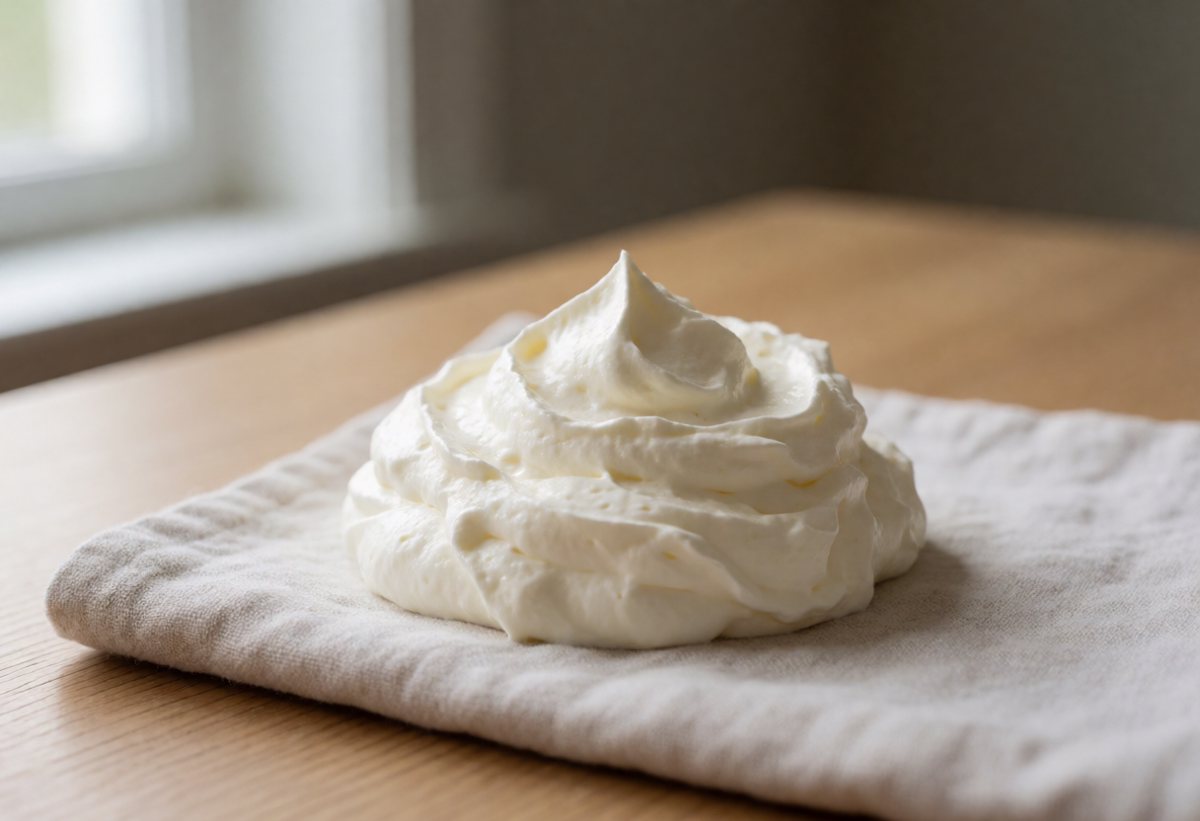
Whipped cream is the simplest and most delicate cake filling, and the most temperamental. It is fat globules holding air. The usual troubles are cream that won’t whip, or cream that turns grainy and buttery because it was overwhipped.
Ingredients and what each one does
- Heavy cream, 33–35% fat. The fat builds the framework that holds the bubbles. With less fat, it won’t whip reliably.
- Icing sugar sweetens and dissolves instantly, with no crystals. The starch in it also steadies the foam a little.
- Vanilla, to taste.
How to make it
- Keep everything cold: cream straight from the fridge (about 4 °C), and a chilled bowl and whisk. Cold fat is firm and holds air; warm fat smears.
- Whip at medium speed. Add the sugar once the cream has begun to thicken.
- Stop at soft peaks: the cream holds the trail of the whisk, but the tip of the peak bends over. That is enough for a filling between layers. For levelling the sides, go to stiff peaks, but no further.
- Finish by hand with a whisk. It is easy to overshoot with a mixer, since the gap between stiff peaks and butter is a matter of seconds.
What can go wrong
- Won’t whip. The cream is warm or its fat content is too low.
- Grainy, buttery. Overwhipped: fat globules clump and whey separates. Stop earlier. Folding in a few spoons of fresh cold cream gently can partly rescue it.
- Collapses after a few hours. Plain whipped cream isn’t stable enough for a tall cake. It can’t carry the weight of the layers; stabilise it with gelatine or mascarpone.
- The cake slides. The cream layer is too thick and the cake too tall; keep the layer moderate.
Substitutions
Gelatine or mascarpone make the foam firmer, at some cost to flavour and texture, so try it on a small piece. Non-dairy whipping cream whips easily and holds its shape, but tastes different. Fine sugar can replace icing sugar, though it dissolves more slowly.
Storage
Whipped cream keeps a day or two in the fridge, then it sinks and weeps. Keep a cake with cream cold and don’t leave it long at room temperature.